Refrigerator Compressor & Start Relay Repair
Hearing a repetitive clicking sound from the lower back of your refrigerator every 2 to 3 minutes while both compartments warm up? Learn how technicians diagnose start relay failure and restore cooling before permanent motor damage occurs.
Why does a refrigerator compressor click every 2 minutes without cooling? The clicking sound is the bi-metal thermal overload switch tripping. When the solid-state PTC start relay burns out or the run capacitor loses microfarad rating, the compressor motor cannot overcome head pressure to turn. It draws Locked Rotor Amps (LRA), overheats in 3 to 5 seconds, and the overload switch snaps open to prevent an electrical fire.
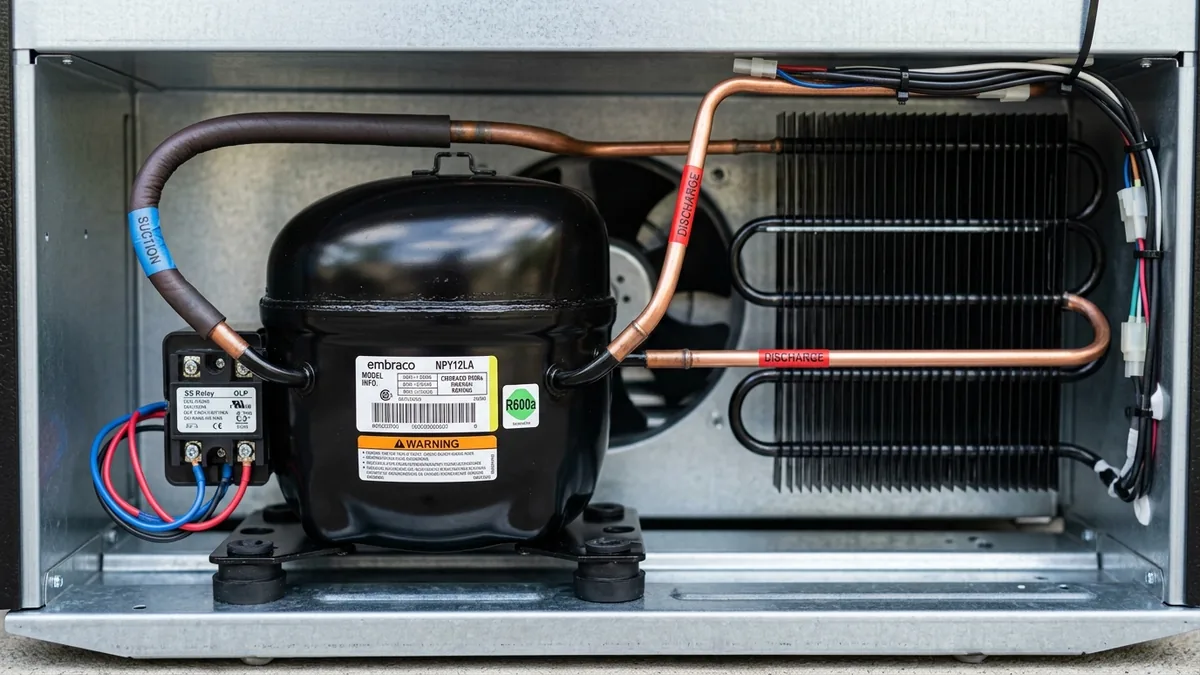
Figure 3.0: Hermetic compressor machine compartment and start relay assembly diagnosed for clicking failure.
The Anatomy of the Hermetic Refrigerator Compressor
The compressor is the heart of your refrigerator's sealed refrigeration system. Inside its welded steel hermetic dome sits an electric induction motor coupled directly to a reciprocating piston or rotary scroll mechanism.
Because single-phase residential AC current cannot produce a rotating magnetic field on its own, the compressor relies on an auxiliary Start Winding in addition to its primary Run Winding.
To initiate rotation against high system head pressure, electricity must pass through a PTC (Positive Temperature Coefficient) Solid-State Start Relay. Once the motor reaches 75% of operational speed (roughly 0.5 seconds), the PTC ceramic disc heats up, its electrical resistance spikes exponentially, and it cuts power to the start winding, allowing the motor to spin efficiently on the run winding alone.
Read our Complete Guide on the 2-Minute Clicking Sound →
Figure 2.1: Hermetic terminal pins (Common, Start, Run) resistance testing and PTC relay inspection.
Why a Burnt Start Relay Causes the Distinctive "Click"
Understanding the electrical chain reaction that triggers the thermal overload protector.
1. Ceramic Disc Disintegration
Inside the plastic PTC start relay housing sits a small circular ceramic pellet. Over 5 to 10 years of thousands of thermal cycles, this ceramic disc becomes brittle and shatters into dust. When a technician shakes a failed relay, it rattles like a maraca.
2. Locked Rotor Amps (LRA) Surge
Without current flowing through the start winding, the motor cannot generate starting torque. The rotor remains stationary (locked), causing current draw to spike from its normal 1.2 Amperes up to 15–25 Locked Rotor Amps (LRA).
3. Thermal Overload Snaps Open
This massive current surge causes the compressor windings to heat violently within seconds. Mounted directly against the compressor shell, the bi-metal overload switch heats to roughly 215°F and snaps open with an audible metallic "CLICK" to prevent a catastrophic fire.
4. Automatic Reset & Continuous Cycling
After approximately 2 minutes, the bi-metal strip cools down and snaps closed. The thermostat immediately attempts to start the compressor again, repeating the failure cycle indefinitely until power is turned off or the motor burns out.
Urgent Advisory: Unplug the Refrigerator Immediately
Allowing a refrigerator to click continuously for hours subjects the compressor motor to severe thermal stress. This repeated heat breaks down the thin enamel insulation coating the copper windings, causing an internal short-circuit. Unplug the refrigerator now to preserve a compressor that can usually be restored with a fast, affordable relay replacement.
How Technicians Test Compressor Windings with a Multimeter
Before installing replacement parts, technicians execute three rigorous electrical tests:
The Terminal Pin Resistance Formula
The compressor has three hermetic copper terminal pins arranged in an inverted triangle: Common (C), Start (S), and Run (R).
A certified technician measures resistance in Ohms across all three pin pairs. A healthy single-speed compressor must strictly satisfy this mathematical formula:
Typical readings on standard residential compressors show Common-to-Run around 3 to 6 Ohms, and Common-to-Start around 5 to 11 Ohms. The Start-to-Run reading must equal the exact mathematical sum (8 to 17 Ohms).
Ground Fault & Inverter Testing
- Short-to-Ground Test: The technician touches one multimeter probe to unpainted compressor steel and tests each pin. Resistance must read infinite (∞ Ohms / O.L.). Any measurable resistance indicates an internal short that trips home GFCI breakers and requires compressor replacement.
- Digital Inverter Compressors: Modern high-efficiency refrigerators (such as Samsung and LG) utilize 3-phase brushless DC inverter compressors. Resistance between all three pins must be exactly equal (typically 6 to 12 Ohms across all pin pairs). Inverter boards are tested for clean 3-phase square-wave output.
Common Questions About Compressor & Relay Failures
Stop the Clicking & Save Your Compressor
Mobile service technicians carry universal start relays and capacitors for immediate same-day restoration.
Call +1 833-379-2204